A missing tooth may be small on an X-ray, yet the decision around it reaches into eating, confidence, time, travel and money. Patients researching process often encounter tidy before-and-after photos and compressed promises. Real treatment is more nuanced. It depends on anatomy, health, restorative goals and the team’s ability to explain uncertainty without turning every possibility into alarm.
This guide is designed to help you read a treatment plan, prepare useful questions and recognize where an individualized examination matters. It does not rank clinics or promise one correct technique. Instead, it makes the clinical logic visible—especially helpful if you are considering care in Medellín from another city or country.
Start with the clinical problem, not the product
Implant treatment is a sequence, not a single appointment: diagnosis, site preparation when needed, implant placement, biological healing, restoration and maintenance. Understanding the handoffs makes the waiting easier to plan.
The implant itself is a small threaded fixture, usually made of titanium, that replaces a root. What you see and chew with is the restoration attached above it. In a single-tooth case that normally means an abutment and crown; in larger cases it may be a bridge or removable overdenture. This distinction matters because surgery can be technically successful while the tooth above it is uncomfortable, hard to clean or visually disappointing.
A careful team therefore plans backward from the final tooth. It studies where the crown must emerge, how it will meet the opposing teeth, how the gums will frame it and whether the planned implant position leaves room for durable components. Choosing an implant from a scan alone, without restorative planning, reverses that sequence.
What a complete assessment should include
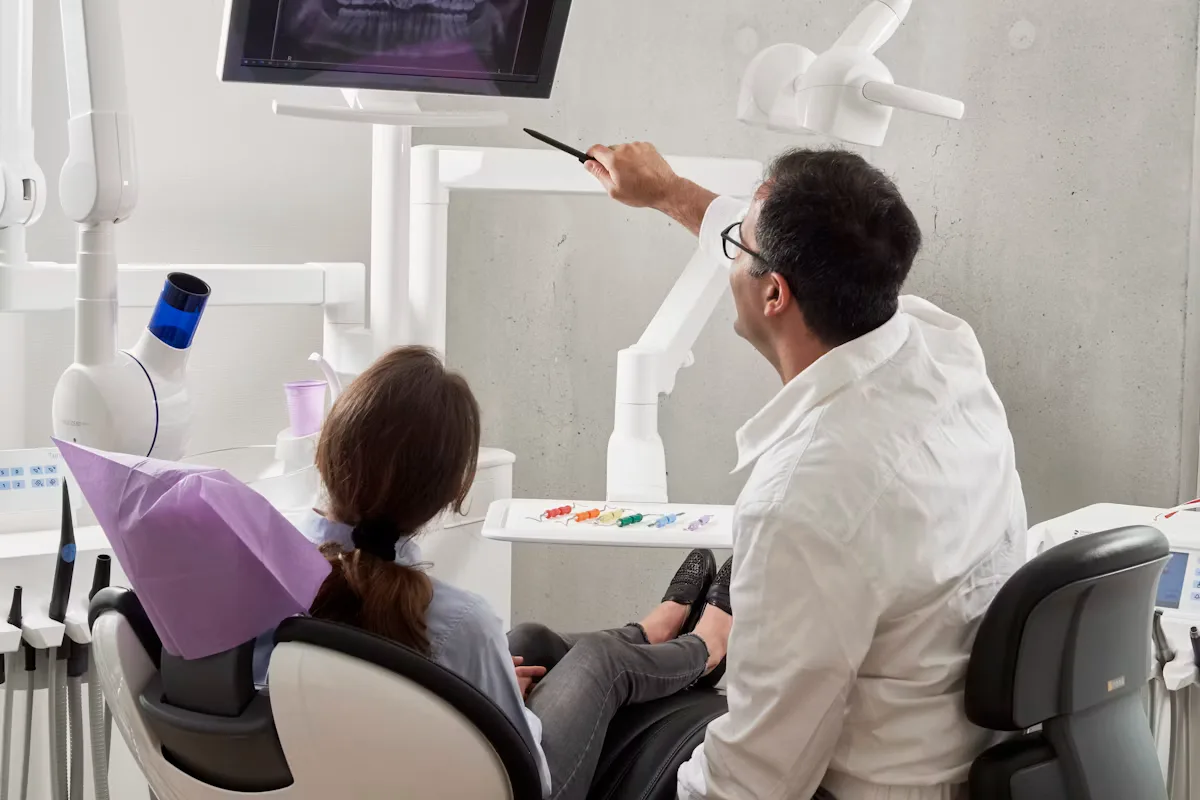
A consultation should feel less like a sales presentation and more like an investigation. The clinician needs to know why the tooth was lost, whether infection remains, how the bite distributes pressure and whether anything in your medical history changes healing. Expect photographs, an oral examination, gum measurements and appropriate imaging. A panoramic X-ray is useful for orientation; a CBCT provides three-dimensional information when surgery is being planned.
Five factors are especially relevant to process:
- Medical and dental history review.
- Cbct-based position planning.
- Atraumatic surgery and primary stability.
- Osseointegration without rushed loading.
- Bite adjustment and long-term maintenance.
None of these items should be interpreted in isolation. Limited bone, for example, does not automatically exclude an implant. It may change implant dimensions, position, timing or the need for grafting. Likewise, age alone is rarely the decisive issue. A healthy older adult with reliable hygiene may be a better candidate than a younger patient with active gum disease and heavy smoking.
The most reassuring treatment plan is not the one with no uncertainty. It is the one that names the uncertainties, shows how they were evaluated, and explains what happens if reality differs from the ideal plan.
The timeline is biological, not merely logistical
Implant care usually has several clocks running at once. The appointment clock covers scans, surgery, impressions and delivery. The biological clock covers soft-tissue closure and the formation of stable contact between living bone and the implant surface. A clinic can make scheduling efficient, but it cannot negotiate away healing.
After diagnosis, an unhealthy tooth may be removed. In selected sites, implant placement can happen during the same visit. In others, infection, a thin socket wall or a large defect makes staged healing more predictable. Once the implant is placed, primary stability comes from mechanical engagement with bone. Over the following weeks, that early stability is replaced by biological integration. Loading too aggressively during this transition can disturb healing.
A temporary tooth may be fixed, removable or omitted depending on location and stability. “Same-day teeth” generally describes a provisional restoration under controlled bite conditions, not completion of all treatment. The definitive crown or bridge is commonly made after tissues stabilize, so contours and contact points can be refined.
For travelers, ask for dates in ranges rather than a single return date. Laboratory remakes, additional healing or a tissue adjustment can alter the calendar. Flexible airfare and buffer days are practical parts of clinical risk management, not luxuries.
Reading costs and quotes without false precision
Published prices are useful only as broad orientation. In Medellín, a straightforward single implant restored with its crown is often discussed in ranges of several million Colombian pesos, while treatment in the United States or Canada may be quoted in several thousand dollars. Full-arch rehabilitation costs much more because it includes multiple implants, extensive surgery, provisional and final prostheses, laboratory stages and many visits. Currency movement also changes the apparent saving for international patients.
The key is scope. Ask whether the estimate includes the consultation, CBCT, extraction, graft, sedation, implant fixture, healing component, abutment, temporary tooth, final restoration and follow-up. Not every patient needs every line, but every line should have a defined status: included, excluded, optional or contingent. Compare like with like and keep a reserve for clinically justified changes.
Lower cost may reflect favorable local operating expenses; it can also reflect a simpler restoration, a lesser-known component system or missing aftercare. Higher cost does not guarantee excellence. Value lies in diagnosis, execution, traceable materials, a maintainable restoration and a team that remains reachable after payment.
How to make the decision more concrete
Before accepting treatment, ask the clinician to show the problem on your images and connect each proposed step to that finding. Then ask what reasonable alternative exists: monitoring, a conventional bridge, a removable tooth, preserving a compromised tooth, a different graft plan or no treatment for now. An ethical explanation includes the consequences of waiting without using fear as a shortcut.
Use these questions during the conversation:
- Ask who performs each surgical and restorative stage.
- Get a calendar that distinguishes visits from healing periods.
- Know which symptoms require a call before you leave the office.
Also ask who is accountable for the final result. Implant treatment may involve a surgeon, periodontist, prosthodontist, general dentist and laboratory technician. Team care can be excellent, but responsibilities must be explicit. Know who chooses the implant position, who designs the restoration, who handles an emergency and who will see you if a screw loosens after you return home.
Planning treatment in Medellín
Medellín is easy to navigate compared with many large cities, and neighborhoods such as El Poblado, Laureles and areas near major medical centers offer abundant lodging. Still, choose accommodation for recovery, not nightlife. A quiet room, elevator, simple food options and a short ride to the clinic matter after surgery. Traffic varies sharply by hour, so measure travel time at the hour of your appointment.
For international patients, a remote review can help estimate complexity, but photos and a panoramic image do not support a final surgical promise. The in-person exam and CBCT may change the plan. Avoid buying a tightly timed, nonrefundable package based on a messaging-app quote. Ask for the clinician’s full name, professional registration, relevant training, clinic address, sterilization process and emergency coverage. Credentials should be verifiable, not implied by social-media production quality.
Bring a concise medical summary, medication list, allergies and contact details for your dentist at home. If sedation is planned, clarify fasting, escort and transport rules. After treatment, request records in digital form: images, procedure notes, implant manufacturer and dimensions, component references, prescriptions and the restoration design when available.
Maintenance, complications and red flags
Implants cannot decay, but the surrounding tissues can become inflamed and lose support. Daily plaque control, professional maintenance and control of bite overload are part of the treatment, not an optional warranty condition invented afterward. Cleaning tools vary with the restoration: a soft brush, interdental brush, floss threader or water irrigator may each have a role. The team should demonstrate rather than simply tell you to “keep it clean.”
Call promptly for bleeding that does not slow with pressure, swelling that worsens after initial improvement, fever, pus, persistent numbness, difficulty swallowing or breathing, a mobile implant, or a provisional restoration that suddenly changes the bite. Minor swelling, bruising and soreness may be expected after surgery, but the trend matters. Severe or escalating symptoms deserve assessment.
Be cautious when a provider guarantees lifetime success, refuses to identify the implant system, discourages a second opinion, demands full nonrefundable payment before diagnosis, or promises a final result from photos alone. A consent form is not a substitute for a two-way discussion.
A sensible next step
For process, the best next step is a diagnosis that results in a written, itemized plan. The document should separate what is known today from what depends on surgical findings and should name the review points before the final restoration.
Take notes, sleep on elective decisions and compare plans by diagnosis and scope rather than headline price. If two qualified clinicians disagree, ask each to explain the anatomy or risk that drives the difference. Sometimes both options are defensible; the better fit depends on your priorities and tolerance for time, surgery and maintenance.
Continue with our guide to the complete implant process, review who is a candidate for implants, and use the broader Medellín dental implant patient guide to organize travel and clinic questions. If bone volume is part of your plan, read when a bone graft is needed.
The practical timeline patients should write down
My consultation script would be: “Please map my best-case and staged timelines, and show me which finding determines each branch.” I would ask who places the implant, who designs the crown, whether a temporary tooth is included and what evidence will show that the implant is ready for restoration. A useful quote separates imaging, extraction, grafting, surgery, components, laboratory work and reviews. Cost changes usually come from anatomy, graft needs, sedation, implant number and restorative material; they should not appear as unexplained additions halfway through treatment.
The first week deserves its own map. Day 0: numbness, mild oozing and fatigue are common. Days 1–3: swelling can peak, so soft food and reduced activity are sensible. Days 4–7: symptoms should trend downward; a rubbing provisional may need adjustment. Week 2: the surface can look healed even though bone integration continues. Over the next months, visits may include uncovering, scans or impressions, a prototype and delivery of the final tooth. Ask exactly when normal chewing resumes rather than guessing from appearance.
Travelers to Medellín should avoid stacking surgery, tourism and a flight into a narrow window. Stay near the clinic until the first check, allow a buffer day and arrange an escort after sedation. Traffic varies markedly by hour. Carry medication details and obtain the CBCT, operative report, implant brand and dimensions, component references and restorative plan for your dentist at home.
Seek prompt help for uncontrolled bleeding, breathing or swallowing difficulty, rapidly increasing swelling, fever with pus, worsening pain after improvement, persistent altered sensation, implant movement or a temporary restoration that suddenly feels high. Also pause if a clinic promises the final crown before examining tissues, will not discuss alternatives, or cannot explain who manages complications.
Use implant aftercare as your recovery checklist and the Medellín guide for trip planning.
This article is educational and cannot replace an examination by a licensed dental professional.